
Trying to choose between Invisalign and traditional braces? You’re not alone. Patients across Honolulu, from Makiki to Waikiki, often ask what the real differences are when comparing their options. Both treatments aim to give you a straighter, healthier smile, but the experience and process of getting there are very different. This article breaks down the pros and cons of each so you can make the choice that fits your life, your smile, and your schedule.
Dr. Eugene Azuma, DDS, brings decades of experience in dentistry and dental sleep medicine. As Vice President of the American Sleep and Breathing Academy, he’s known for combining technical precision with personalized care. Whether you’re a teen in Mānoa or a professional working in Downtown Honolulu, Dr. Azuma helps patients find the orthodontic treatment that works best for their goals, comfort, and daily routines.
How Do Invisalign and Braces Actually Work?
Invisalign uses a series of clear, removable aligners to gradually move your teeth into better alignment. These aligners are custom-made using 3D digital scans, allowing for a snug and comfortable fit. You’ll wear each set of aligners for about 1–2 weeks, taking them out only to eat, drink, brush, or floss.
Traditional braces rely on metal brackets bonded to your teeth and connected with wires and elastic bands. These are adjusted by your orthodontist at regular intervals to guide your teeth into their proper position. Since they are fixed to the teeth, you wear them 24/7 throughout your treatment.
Both Invisalign and braces are effective at achieving a straighter smile. The key difference lies in how the treatment integrates into your daily life and the type of dental corrections you may need.
Key Lifestyle Considerations for Honolulu Patients
When it comes to choosing an orthodontic solution, daily habits and routines play a big role in the decision. From Pacific Heights to Kaimuki, patients often base their choices on convenience, flexibility, and how treatment will impact their lifestyle. It’s important to think about how committed you are to maintaining the system you choose.
Invisalign offers flexibility because the trays can be removed for meals and special events. That’s a big plus for patients with active social lives or unpredictable schedules. However, this freedom comes with the need for self-discipline. The aligners must be worn for 20 to 22 hours a day to work effectively, and skipping time can delay results.
Unlike Invisalign, braces are fixed to your teeth, so you never forget to wear them. But they do require more care. You’ll have to avoid sticky, hard, or crunchy foods that could damage the brackets or wires. Brushing and flossing can also take more effort because of the hardware in place.
Oral hygiene is often easier with Invisalign since there are no brackets or wires to work around. You simply remove the trays and clean your teeth like normal. With braces, you’ll need to use special tools and techniques to get into all the nooks and crannies. Patients in McCully-Moiliili and Ward Village who prioritize comfort and convenience often lean toward Invisalign. However, those with more complex alignment cases may find traditional braces to be a more reliable solution.
Pros and Cons of Each Option
If you’re comparing braces and Invisalign, it helps to look at the benefits and drawbacks side-by-side. Patients in neighborhoods like Punahou, Palolo, and Kapahulu often mention different reasons for their choice, and both systems have their strong points. Making the right decision often means understanding not just the technical aspects, but how each system will impact your day-to-day routine.
Invisalign Pros:
- Nearly invisible, ideal for professionals and teens who want discreet treatment.
- Removable trays allow freedom to eat your favorite foods without restriction.
- Easier to brush and floss without the obstacles of wires or brackets.
- Fewer emergency visits since there are no brackets or wires to break.
Invisalign Cons:
- Requires strong commitment to wear aligners 20–22 hours a day.
- Aligners can be misplaced or forgotten if not stored properly.
- May not be ideal for correcting severe bite or alignment issues.
Braces Pros:
- Effective for a wide range of dental problems, including severe misalignments.
- Always working since they’re fixed, you can’t forget to wear them.
- Tried-and-true results backed by decades of orthodontic use.
Braces Cons:
- Visible metal hardware may affect self-confidence for some.
- Certain foods must be avoided to prevent damage to brackets.
- Cleaning requires extra effort and tools to maintain oral hygiene.
- Occasional soreness after adjustments is common.
Dr. Azuma works closely with each patient to determine which option will deliver the best results based on their goals, comfort preferences, and treatment needs. Whether you’re prioritizing discreet wear, complex correction, or ease of use, there’s a solution designed to work with your lifestyle. A clear understanding of the pros and cons will help you feel confident moving forward.
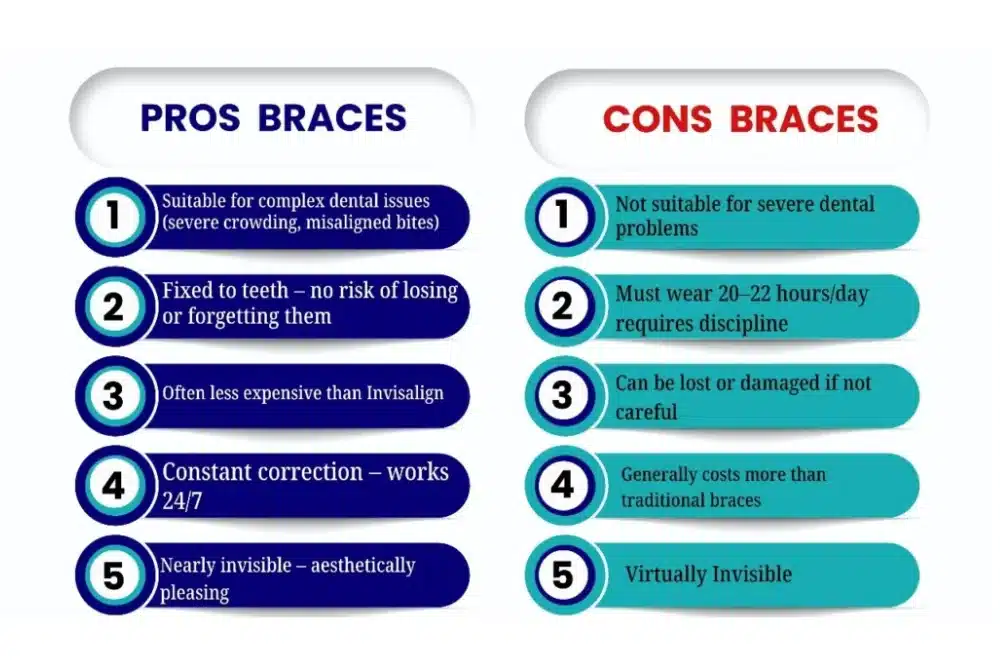
Invisalign vs Braces Comparison Table
Understanding the key differences between Invisalign and traditional braces can help clarify which approach is better for your needs. Some patients prioritize flexibility and appearance, while others need the reliability of a fixed solution for more involved orthodontic work.
| Feature | Invisalign | Traditional Braces |
| Visibility | Nearly invisible | Metal brackets and wires |
| Comfort | Smooth, no wires | May cause irritation |
| Removability | Removable | Fixed to teeth |
| Diet | No restrictions | Many food limitations |
| Cleaning | Brush/floss normally | Requires special care |
| Best for | Mild to moderate cases | Moderate to severe cases |
| Office visits | Fewer needed | More frequent adjustments |
Patients in Ward Village and the King Street Corridor who want a low-profile orthodontic solution often favor Invisalign. Those with more intensive alignment needs tend to select braces because of their strength and precision. Each option has its own advantages, and the right choice often comes down to personal preference, lifestyle compatibility, and the level of correction required.
What to Expect During Treatment
Your treatment journey with either system will follow a personalized plan designed by Dr. Azuma and his team. Every patient’s needs are different, and our Honolulu office focuses on making the experience as smooth and supportive as possible.
- Invisalign: You’ll receive a series of custom aligners that are switched out every one to two weeks. Most patients begin to see visible progress within just a few weeks. Appointments are generally shorter and less frequent.
- Braces: You’ll visit the office every four to six weeks for wire adjustments and progress checks. Total treatment time typically ranges from 18 to 24 months depending on case complexity. Soreness after adjustments is normal but manageable.
- Monitoring: Whichever option you choose, Dr. Azuma and his team will track your results closely. We’ll make sure everything stays on track and provide quick solutions if anything comes up.
Patients from Tantalus to Keeaumoku often comment on how supported they feel throughout treatment. Consistent communication and local understanding help make your orthodontic experience more comfortable and effective from start to finish.
Choosing the Right Option for Your Smile
Choosing between Invisalign and braces ultimately comes down to which option fits better into your daily life. Invisalign offers a subtle, removable solution that appeals to those who value convenience and appearance. Braces, on the other hand, provide continuous correction and are better suited for complex dental adjustments.
Dr. Azuma and his Honolulu-based team are here to help you make the best decision. During your consultation, we’ll review your dental goals, scan your teeth, and explain how each option could help you achieve the smile you’ve always wanted. We take your lifestyle and long-term results into account.
Schedule your Invisalign or braces consultation today by calling (808) 528-2221 or visiting Dr. Eugene Azuma, DDS.
Frequently Asked Questions
Which option is faster: Invisalign or braces?
Patients want to choose the option that fits both their lifestyle and their desired timeline.
What they should ask instead: For my specific case, which option is likely to finish sooner, and why?
- Immediate Insight: On average, Invisalign cases are often quoted around 12–18 months for mild to moderate issues, while traditional braces are more often in the 18–24 month range, though both can fall outside those windows.
- Supporting Context: The American Association of Orthodontists emphasizes that total treatment time depends more on how complex your bite and crowding are, and how consistently you follow instructions, than on whether you choose aligners or braces.
- Deeper Implication: For simple alignment problems, Invisalign may finish faster; for more complex movements, braces can actually be more efficient. Your orthodontist’s exam is what really determines the “faster” option for you.
Do braces work better than Invisalign?
Patients want to balance esthetics with getting the best possible result.
What they should ask instead: For which kinds of problems are braces clearly better, and when is Invisalign enough?
- Immediate Insight: Both braces and Invisalign are effective, but traditional braces generally give orthodontists more control for severe crowding, large bite corrections, and complex jaw or tooth‑movement patterns.
- Supporting Context: Harvard‑aligned and orthodontic sources note that clear aligners work very well for many mild to moderate cases, while braces are often preferred for significant rotations, large space closures, or difficult bite/jaw issues.
- Deeper Implication: “Better” depends on your diagnosis: if your case is complex, braces may be recommended; if it’s moderate and you can comply well, Invisalign can offer comparable results with a more discreet look.
Can teens use Invisalign?
Teens want discreet options, while parents worry about effectiveness and compliance.
What they should ask instead: When is Invisalign Teen a good fit, and how do we know a teen will use it correctly?
- Immediate Insight: Yes, Invisalign can work very well for teens with mild to moderate orthodontic problems, especially when they’re motivated and responsible with wear time.
- Supporting Context: The American Association of Orthodontists supports clear aligner use in teens under orthodontist supervision; teen versions often include blue compliance indicators that fade with proper wear, helping parents and doctors track use.
- Deeper Implication: For social or active teens who can commit to 20–22 hours a day of wear, Invisalign can be an effective, lower‑profile alternative to braces; for less consistent wearers or more complex cases, braces may still be the better choice.
Are there payment plans for either option?
Cost is a major concern, and patients need to know if finances can be spread out.
What they should ask instead: How can I make Invisalign or braces affordable, and what will insurance actually cover?
- Immediate Insight: Yes, most orthodontic practices, including Dr. Azuma’s, offer payment plans or third‑party financing for both Invisalign and braces, allowing you to pay over time instead of all at once.
- Supporting Context: The ADA and AAO both encourage patients to review their dental or orthodontic insurance benefits before starting; many plans cover a portion of medically necessary orthodontic treatment for children, and some offer adult benefits as well, usually with a lifetime ortho maximum.
- Deeper Implication: A benefits check plus an in‑office financial consult lets you see how much insurance contributes, what monthly payment fits your budget, and whether one option (braces vs Invisalign) aligns better with your coverage.