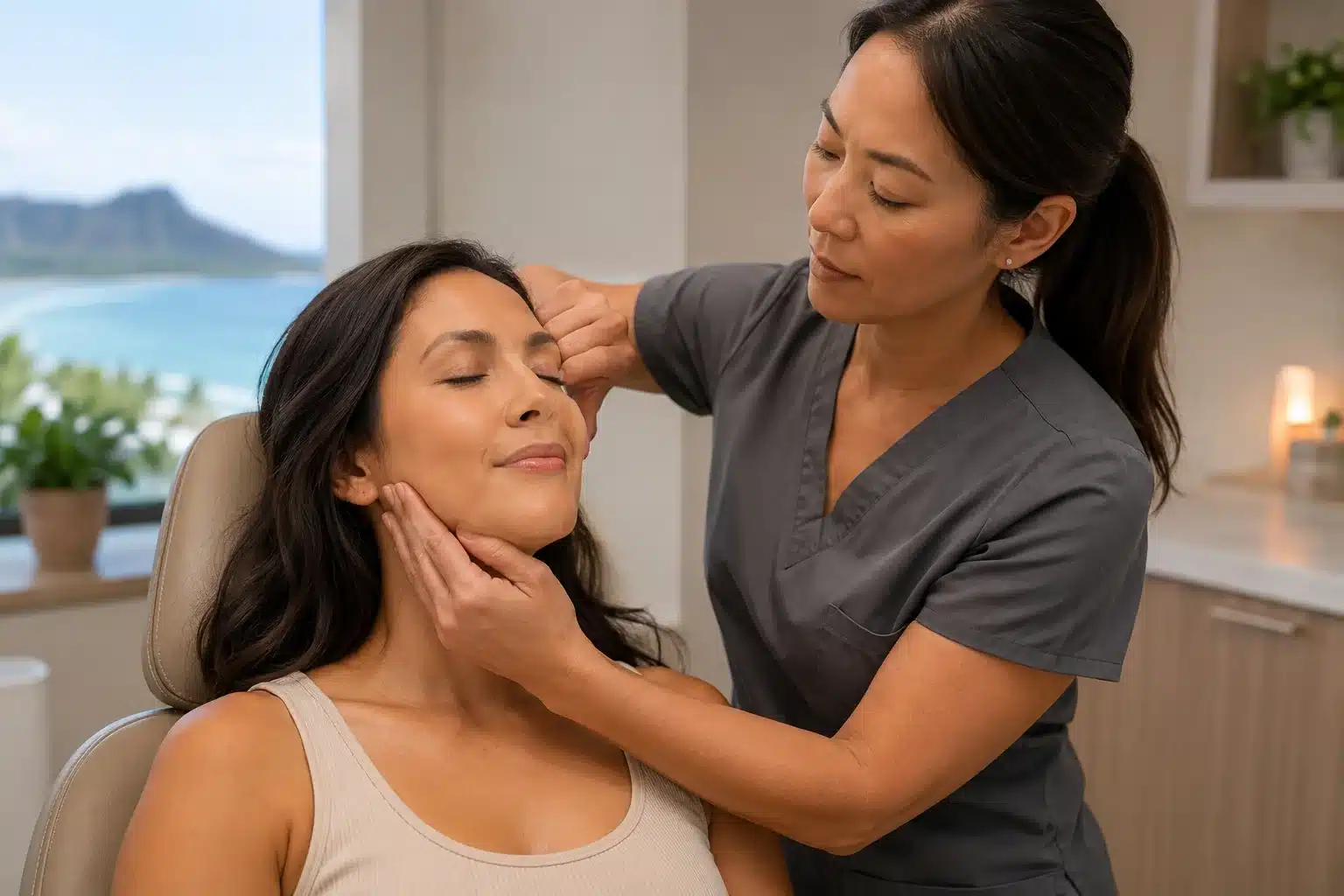
Massage helps TMJ pain by loosening the tight jaw muscles behind it. A review of 20 randomized trials found hands-on therapy widened mouth opening by 1.6 to 3.6 millimeters. The National Institute of Dental and Craniofacial Research puts TMD prevalence at about 5 percent of adults. Two minutes a day costs you nothing.
Here is what most people miss. You can rub your jaw for weeks and still wake up sore. The rubbing never reaches the reason. Dr. Eugene Azuma DDS sees that same loop at his Honolulu dental practice all the time. He offers TMJ therapy in Honolulu for people stuck in it. Let’s go through what works, and where massage stops helping.
Does Massage Really Help TMJ Jaw Pain?
Yes, and researchers measured how much. In that review of 20 trials, people opened wider after hands-on therapy. Their pain scores dropped too, in the short term and later on. You notice a change like that every time you yawn. Or bite into a musubi.
So why does it work? Your jaw muscles never clock out. They fire when you chew, talk, swallow, and clench, all day long. Hold them tight for a few weeks and they knot up. Massage loosens those knots and pulls fresh blood into sore tissue. Know the catch, though. It calms the muscle without touching whatever made the muscle angry.
Which Jaw Muscles Cause Most of Your TMJ Pain?
Want to find the culprit? Put two fingers on your cheek, right under the cheekbone. Now clench. That thick band pushing back at you is the masseter. It handles most of your chewing, and it causes most of your pain.
Two other muscles join in. The temporalis spreads across your temple, which is why the ache creeps up above your ear. The muscles running down the side of your neck send pain into the jaw as well. Sit at a Downtown Honolulu desk all day and your shoulders lock up. By dinner, your jaw is paying for it.
What TMJ Massage Techniques Can You Do at Home?
One rule before you start. Pressure should feel like a firm stretch, never like pain. If a spot hurts more while you press it, ease off. Keep your teeth slightly apart so the muscle stays loose.
- Circular kneading: press two fingers into the masseter and circle slowly for 30 seconds per side.
- Temple press: rest fingertips on your temples and press gently while opening and closing your mouth.
- Cross friction: move your fingers side to side across the muscle fibers, not up and down.
- Opening stretch: rest your tongue on your palate, then open until you feel a light pull.
Short and often beats long and rare. Two or three minutes, twice a day, does more than one weekend marathon. A professional session usually runs about 30 minutes. Most people feel their jaw loosen inside the first week.
What Daily Habits Keep Your Jaw Muscles Tight?
You loosen the muscle in the morning. Then your day tightens it right back up. These five are the usual suspects.
- Clenching your teeth while you stare at a screen or sit in Ala Moana traffic.
- Chewing gum, ice, or tough foods for long stretches.
- Holding your phone between your shoulder and your ear.
- Sleeping on your stomach with your face pressed into the pillow.
- Carrying stress into the night, which turns into grinding.
Daytime habits you can catch and fix yourself. Nighttime teeth grinding is a different animal, since you are asleep for it. A custom night guard for grinding shields your teeth and takes load off the joint. Plenty of Makiki and Kakaʻako patients report less morning soreness within a few weeks.
Self-Massage or Professional Care: Which Is Right for You?
This is not an either-or. Self-massage covers your daily upkeep. Professional care answers the bigger question of why your jaw got this way. Find yourself in the table below.
| Self-massage at home | Professional TMJ care | |
| Time per session | 2 to 3 minutes | About 30 minutes |
| Cost | Free | Varies; oral appliances run $200 to $1,000 |
| Best for | Mild tension, daily upkeep | Pain lasting more than a few weeks |
| What it does | Loosens tight muscle, eases soreness | Finds the cause, checks teeth for wear, treats grinding |
| What it cannot do | Stop nighttime grinding on its own | Replace daily care between visits |
| When to start | Today | When pain returns every morning |
Start with the home version. Most people get real relief right there. If pain still greets you every morning after a few weeks, the muscle is not the story. That is your cue to get it looked at properly.
When Does Jaw Pain Need More Than Massage?
Waking up sore every single morning? Then the trouble is happening overnight, and daytime massage never gets near it. Clenching can load your jaw for hours while you sleep. You feel the result at breakfast without ever feeling the cause. A few signs mean stop self-treating and get looked at. A jaw that locks open or shut needs same-day attention. So does pain spreading into your ear. Same goes for a mouth that will not open wide enough to eat.
This is where Dr. Azuma’s background matters. Dr Azuma earned his Doctor of Dental Surgery at Georgetown University School of Dentistry. He founded Hawaii Dental Sleep Medicine, LLC in 2016. Dr Azuma also serves as Vice President of the American Sleep and Breathing Academy. He holds diplomate certification there as well. So he looks at your jaw and your breathing together, not one at a time. Morning pain and breathing often travel together. That overlap sits at the heart of dental sleep medicine. Snoring loud enough to wake the house? Sleep apnea treatment may belong in the conversation.
Ready to Stop Waking Up With a Sore Jaw?
Nobody signs up for a jaw that aches through breakfast. You have tried the circles, the warm washcloth, the softer foods. Keep doing those, because they help. But when the pain keeps coming back, you need more. Someone should check the joint, your teeth, and your sleep. Dr. Eugene Azuma DDS at Eugene M. Azuma DDS, Inc. does that for patients across Honolulu.
The plan is short. Call the office, sit down with Dr. Azuma for an assessment, and leave with a plan built around your jaw. Not sure whether your sleep plays a part? Dr. Azuma offers a free sleep screening quiz as a first step. Imagine dinner without shifting your bite. Imagine waking up and not reaching for your cheek. Schedule your consultation today at (808) 528-2221, or request an appointment online.
Frequently Asked Questions
How often should I massage my jaw for TMJ pain?
Two or three minutes, twice a day. Short and steady beats one long weekly session, because the muscle tightens back up between rounds. Professional appointments usually run about 30 minutes, and some patients book them weekly or monthly. At home, slow circles on the masseter are the easiest technique to repeat. Start morning and night, then adjust after a week.
Can TMJ massage make jaw pain worse?
It can, if you go at it too hard. Jaw muscles answer to gentle, steady pressure rather than force. The trials showing real benefit used moderate intensity, not maximum. Clinicians describe the goal as restoring normal muscle tone, not overpowering the muscle. Stop if soreness climbs during or after a session, then have a dentist check the joint.
Is intraoral massage safe to do on myself?
No, leave that one to a professional. Intraoral means working the muscles from inside your mouth. It takes gloves, trained hands, and knowledge of where the nerves run. Do it yourself and you risk bruising tissue or stirring up an inflamed joint. With TMD affecting about 5 percent of US adults, plenty of people try this at home. Stick to outside-the-cheek techniques and ask your dentist about the rest.
How long until TMJ massage starts working?
Most people feel looser jaw movement inside the first week. Measured gains in mouth opening showed up across trials, and held at longer follow-up. Results vary with how long your jaw has been tight and what caused it. Because jaw pain has many possible causes, timelines differ from person to person. Give it four weeks of daily work. No change by then means book an exam.